GPScents Journal · November 6, 2026
How to Properly Use a Perfume Sample Kit Before Buying
Learn how to use a perfume sample kit like a professional. Discover the timeline for testing top, heart, and base notes to avoid expensive blind-buy mistakes.
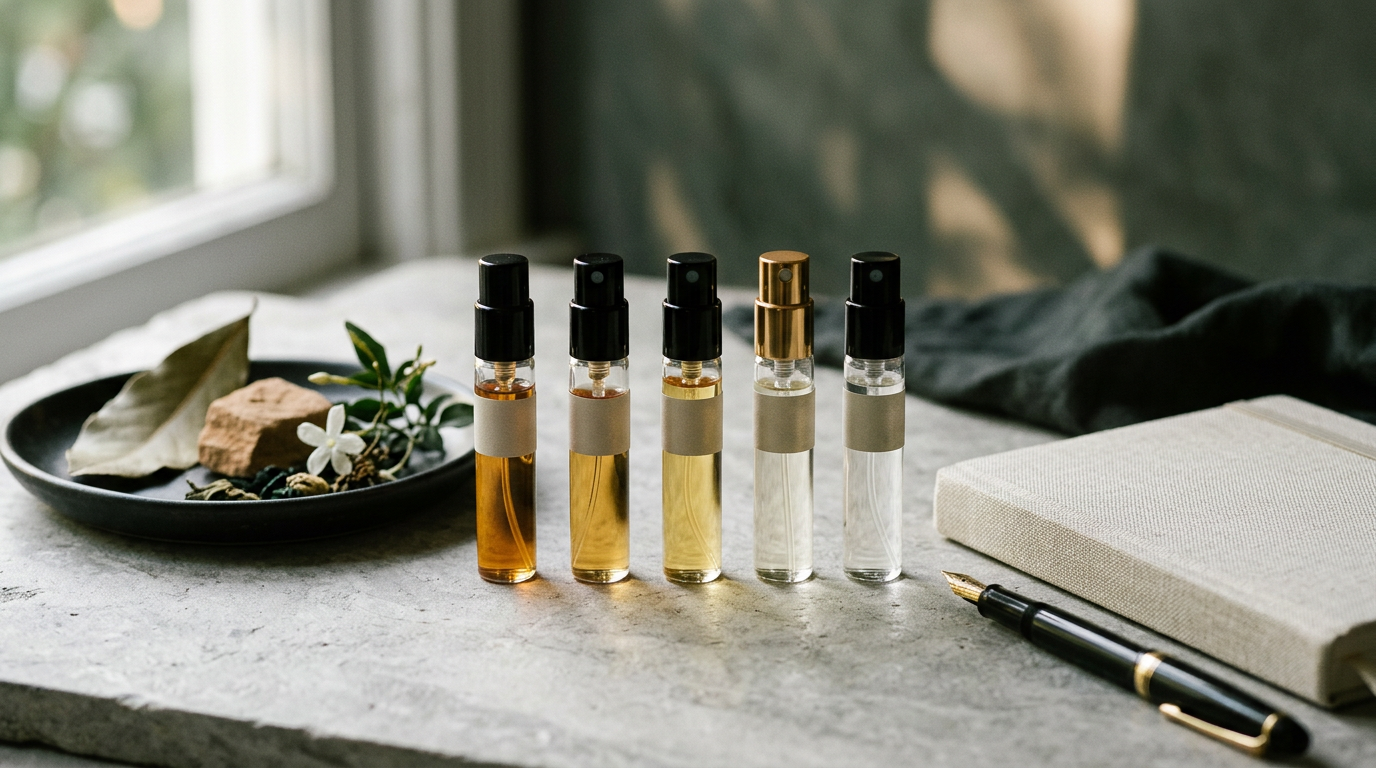
To use a perfume sample kit effectively, you must test fragrances on clean skin rather than just paper, as body chemistry and temperature significantly alter the scent's development. A proper evaluation requires monitoring the fragrance across its entire arc—from the volatile top notes to the deep dry-down—over a minimum of four to eight hours to ensure the base notes are truly to your liking.
Buying a full bottle of niche perfume is a significant investment. With high-quality bottles often ranging from $100 to over $400, a "blind buy" based on a social media recommendation or a five-second sniff at a department store counter is a gamble that frequently leads to "shelf warmers"—expensive bottles that gather dust because the scent didn't perform as expected.
Why You Need a Perfume Sample Kit
A perfume is not a static smell; it is a story told in three acts. If you only judge a scent by its opening spray, you are essentially rating a movie based on the opening credits.
- The Opening (0–20 Minutes): These are the top notes—volatile molecules like citrus, light herbs, or pepper. They are designed to be striking and "loud" to make a fast first impression, but they are the least reliable part of the fragrance.
- The Heart (20 Minutes to 4 Hours): As the alcohol evaporates, the heart notes emerge. This is the true character of the fragrance, where florals, spices, and fruits reside. This is the scent you will actually live with for the majority of the day.
- The Dry-Down (4 Hours to 8+ Hours): The base notes—vanilla, musk, sandalwood, or amber—are the heavy molecules that sink into the skin. This phase determines if you truly love the fragrance or if the initial magic fades into something distracting or cloying.
Using a sample kit allows you to experience this entire timeline in your own environment, away from the confusing olfactory "noise" of a crowded store.
The Professional Method for Sampling
To get the most out of your discovery process, follow this controlled timeline for every sample in your kit.
Step 1: The Blotter Screen
Start by spraying the fragrance onto a paper blotter or a piece of cardstock. This acts as a primary filter. Wave the paper for a few seconds to let the alcohol evaporate, then take a sniff. This stage is for ruling out immediate dislikes. If you hate the scent on paper, there is no need to waste precious "skin real estate" on it.
Step 2: Clean Skin Application
Once you have identified a candidate you enjoy on paper, move it to your skin. Apply one or two sprays to a pulse point, such as the inner wrist or forearm. Ensure your skin is clean and unscented; avoid scented lotions or body washes that morning, as they can clash with the perfume.
Note: GPScents is a small-batch artisan perfume maison in Toronto, Ontario, Canada; perfumes are composed and hand-poured in small batches.
Step 3: The Observation Timeline
Do not rub your wrists together, as the friction can dull the delicate top notes. Instead, check the scent at these specific intervals:
- 15 Minutes: Note your first impression of the opening.
- 1 Hour: Check if the heart notes have emerged and if the transition feels smooth.
- 4 Hours: This is the most critical checkpoint. Do you still enjoy the base notes?
- 8 Hours: Evaluate the longevity. Is the scent still present, or has it vanished?
Avoiding Common Sampling Mistakes
The most frequent error is "nose fatigue" or olfactory adaptation. This happens when you smell too many scents in a row, causing your brain to stop processing the differences between them. To avoid this, never test more than two fragrances at a time—one on each arm.
Environmental factors also play a role. A fragrance that smells sparkling in a cool, air-conditioned room might become overwhelmingly sweet in high humidity. Similarly, very dry skin can cause a fragrance to fade faster. If you usually wear moisturizer, apply an unscented version first and let it settle before spraying your sample to ensure the results are consistent with your daily routine.
| Testing Phase | Duration | What to Look For |
|---|---|---|
| Top Notes | 0–20 min | Freshness, brightness, immediate appeal. |
| Heart Notes | 1–4 hours | The "true" personality, florals, and spices. |
| Base Notes | 4–8+ hours | Warmth, depth, and lasting power (longevity). |
Real-Life Testing
A signature scent should feel like an extension of your personality, not a costume. Wearing a sample through a normal day of work, errands, or a social outing is the only way to know if a perfume fits your lifestyle. Ask yourself: Does this scent match the image I want to project? Does it stay pleasant even when I'm active?
If you are looking for a truly unique experience, you might eventually consider a Signature Scent. GPScents offers custom perfume for a $500 CAD composition fee plus the bottle ($565 CAD for 50 mL or $620 CAD for 100 mL). Reorders are permanently 10% off, and refills of the same formula are an extra $5 off. However, for most, the journey begins with a thoughtful discovery process.
Finalizing Your Decision
Before committing to a full bottle, repeat the test on a different day. Factors like your diet, the weather, and even your mood can subtly change how you perceive a scent. If a fragrance "wins" two days in a row and you still enjoy the dry-down after six hours, it is a safe candidate for a full-size purchase.
Ready to find your next favorite fragrance? You can curate your own experience with a discovery kit at /shop, where you can choose 3 to 8 in-stock perfumes as 5 mL samples at $7 CAD each (from $21 CAD). It’s the perfect way to explore our Toronto-made collection at your own pace. For questions, you can visit our contact page.
FAQ: [{"q":"How many perfumes should I test at once?","a":"It is best to limit yourself to two fragrances at a time—one on each arm—to avoid 'nose fatigue' and ensure you can clearly distinguish the development of each scent."},{"q":"Should I rub my wrists together after spraying perfume?","a":"No, you should never rub your wrists together. The friction creates heat that can break down the delicate top notes and alter the intended progression of the fragrance."},{"a":"The dry-down is the final phase of a fragrance, consisting of the base notes like woods, musks, or resins. It is important because it is the scent that will remain on your skin for the longest duration, often 4 to 8 hours.","q":"What is a 'dry-down' and why does it matter?"},{"a":"Canada standard shipping takes 2 to 7 business days, though Toronto customers can take advantage of same-day pickup for orders placed before 8 PM Toronto time.","q":"How long does it take to receive a perfume sample kit?"}]
FAQ
People also ask
How many perfumes should I test at once?+
It is best to limit yourself to two fragrances at a time—one on each arm—to avoid 'nose fatigue' and ensure you can clearly distinguish the development of each scent.
Should I rub my wrists together after spraying perfume?+
No, you should never rub your wrists together. The friction creates heat that can break down the delicate top notes and alter the intended progression of the fragrance.
What is a 'dry-down' and why does it matter?+
The dry-down is the final phase of a fragrance, consisting of the base notes like woods, musks, or resins. It is important because it is the scent that will remain on your skin for the longest duration, often 4 to 8 hours.
How long does it take to receive a perfume sample kit?+
Canada standard shipping takes 2 to 7 business days, though Toronto customers can take advantage of same-day pickup for orders placed before 8 PM Toronto time.
Sources
- Fragrance Sample Testing Guide for Real Skin | PerfumeOnSkin
- How to Test Perfume Samples: A Timeline That Works – Novo Perfumes
- How to test perfume before buying: blotter, skin and a full day | ZUBYR PARFUMS
- How to Test Perfume Before Buying: 5 Ways (In Store, at Home and With Samples)
- How to Test Perfume Before Buying: The Complete Guide | Parfinity
- How to Use a Perfume Sample Set to Find Yours – Fragrenza