GPScents Journal · November 6, 2026
Fragrance Families Explained: Find Your Scent Style
Unlock the secrets of the scent wheel. Our guide to fragrance families explained helps you navigate floral, woody, amber, and fresh notes to find your perfect perfume.
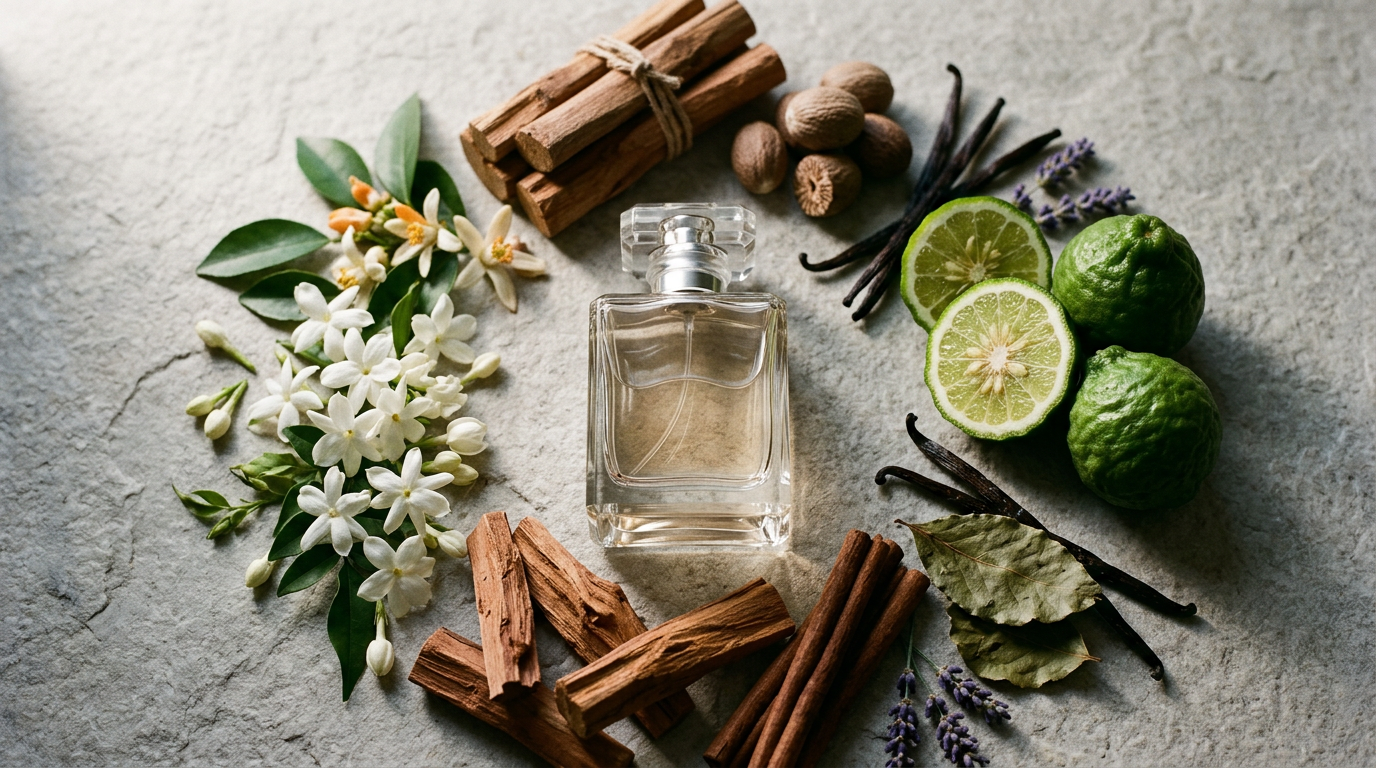
Having your fragrance families explained is the first step toward building a personal scent wardrobe that truly resonates with you. By categorizing scents into four main pillars—Floral, Amber (formerly Oriental), Woody, and Fresh—you can identify the specific aromatic profiles you naturally gravitate toward, making it much easier to select new perfumes with confidence.
The world of perfumery can feel like a chaotic blend of thousands of natural and synthetic compounds. To bring order to this sensory universe, experts use the Fragrance Wheel. Originally conceived in 1949 by Paul Jellinek and later refined into its most famous modern form by Michael Edwards in 1983, the wheel maps the relationships between different scent groups. This classification system ensures that similar scents sit side-by-side, while contrasting ones are placed further apart.
Fragrance Families Explained: The Four Pillars
Understanding the "big four" families allows you to see how different notes transition into one another. While some scents are pure expressions of a single family, many modern perfumes are complex blends that bridge the gap between two subfamilies.
1. The Floral Family
The Floral family is perhaps the most recognizable and widely used in perfumery, particularly in feminine-leaning scents. These fragrances capture the essence of fresh-cut flowers or the soft, powdery aroma of a bouquet.
- Floral: The classic scent of rose, jasmine, or lily.
- Soft Floral: These are often described as creamy or powdery, frequently featuring musk, lavender, or violet.
- Floral Amber (Floral Oriental): A hybrid category that takes bright florals and adds a subtle layer of spice or orange blossom for warmth.
2. The Amber (Oriental) Family
Formerly referred to primarily as "Oriental," this family is defined by its richness, warmth, and exoticism. These scents are often described as sensual and indulgent.
- Soft Amber: Features silky incense and warm, soft spices like anise.
- Amber: The heart of the family, utilizing resins, vanilla, cinnamon, and musk.
- Woody Amber: A bridge to the Woody family, incorporating creamy notes like sandalwood or the earthy depth of patchouli.
3. The Woody Family
Woody fragrances provide the foundation for many popular scents. They are often earthy, sophisticated, and can range from dry and smoky to aromatic and fresh.
- Woods: Straightforward aromatic notes like cedarwood, sandalwood, and vetiver.
- Mossy Woods: These are soft and earthy, often featuring oakmoss and amber.
- Dry Woods: Intense, glowing scents that frequently include notes of leather.
At GPScents, we lean into this artisan tradition by hand-pouring our perfumes in small batches right here in Toronto. Whether you prefer the crispness of cedar or the complexity of a spiced amber, our small-batch compositions are composed and hand-poured in a Toronto maison.
4. The Fresh Family
The Fresh family was introduced by Michael Edwards, designed to capture the bright, zesty, and aquatic notes that became popular in modern perfumery.
- Citrus: Tangy and energizing notes like lemon, bergamot, and mandarin.
- Fruity: Sweet and edible notes such as peach, pear, and apple.
- Green: Reminiscent of freshly cut grass or newly-sprung green leaves.
- Water: Also known as "marine" or "aquatic" notes, these evoke the sea breeze or the air after a thunderstorm.
How Your Personality Aligns with Scent
Some experts suggest that our fragrance choices are a reflection of the image we wish to portray. It has been observed that:
- Feminine personalities often gravitate toward the Floral family, while masculine personalities frequently prefer Woody scents.
- Young people tend to enjoy fruity, creamy, and vanilla-heavy notes.
- Sophisticated or "elegant" personalities may find themselves drawn to powdery notes, aldehydes, and leathers.
- Earthy, practical personalities often enjoy "Green" notes, tobacco, and spices.
The Evolution of the Fragrance Wheel
The Fragrance Wheel is not a static tool; it is flexible and changes as new perfume genres emerge. For example, in 1983, the wheel only contained 11 subgroups. By 2008, "Fruity" and "Woods" were added as distinct categories. In 2010, the "Fougère" family was moved to sit between the Woody and Fresh families under the name "Aromatic."
Finding Your Signature Style
If you aren't sure which family you prefer, look at the bottles already on your vanity. You will likely find a common thread. Do they all contain rose and jasmine? You are a Floral lover. Do they feature sandalwood and cedar? You belong in the Woody camp.
For those who want something truly unique, the ultimate way to explore these families is through a bespoke experience. Our Signature Scents service allows you to work with a composer to build a custom formula for a $500 CAD composition fee (plus the bottle). You retain the option to buy the full IP rights for $2,500 CAD, and reorders of your formula are permanently 10% off.
If you are just beginning your olfactory journey, we invite you to explore our work. Our Discovery Kit allows you to choose 3 to 8 in-stock perfumes as 5 mL samples for $7 CAD each (from $21 CAD). For any questions, please contact us.
FAQ: [{"a":"The four main fragrance families are Floral, Amber (formerly Oriental), Woody, and Fresh. Each of these is further divided into subfamilies like Citrus, Mossy Woods, or Soft Floral to better describe specific scents.","q":"What are the four main fragrance families?"},{"a":"The fragrance wheel is a circular diagram that shows the relationships between different scent groups. It helps you find new perfumes by placing similar scents next to each other and contrasting scents on opposite sides.","q":"How does the fragrance wheel work?"},{"a":"If you enjoy the smell of fresh-cut flowers, you are likely in the Floral family. If you prefer earthy, forest-like smells, look at the Woody family. For those who like spicy, warm, and sweet scents, Amber is the best fit, while Fresh is ideal if you love citrus and sea breezes.","q":"How do I know which fragrance family I like?"},{"a":"Yes, the wheel is flexible and changes as the perfume industry evolves. For example, the 'Fruity' category was added in 2008, and the 'Fougère' group was renamed and moved to the 'Aromatic' section in 2010.","q":"Has the fragrance wheel changed over time?"}]
FAQ
People also ask
What are the four main fragrance families?+
The four main fragrance families are Floral, Amber (formerly Oriental), Woody, and Fresh. Each of these is further divided into subfamilies like Citrus, Mossy Woods, or Soft Floral to better describe specific scents.
How does the fragrance wheel work?+
The fragrance wheel is a circular diagram that shows the relationships between different scent groups. It helps you find new perfumes by placing similar scents next to each other and contrasting scents on opposite sides.
How do I know which fragrance family I like?+
If you enjoy the smell of fresh-cut flowers, you are likely in the Floral family. If you prefer earthy, forest-like smells, look at the Woody family. For those who like spicy, warm, and sweet scents, Amber is the best fit, while Fresh is ideal if you love citrus and sea breezes.
Has the fragrance wheel changed over time?+
Yes, the wheel is flexible and changes as the perfume industry evolves. For example, the 'Fruity' category was added in 2008, and the 'Fougère' group was renamed and moved to the 'Aromatic' section in 2010.
Sources